

Beyond Execution: How India GCCs Are Making the Value Leap to Product Ownership

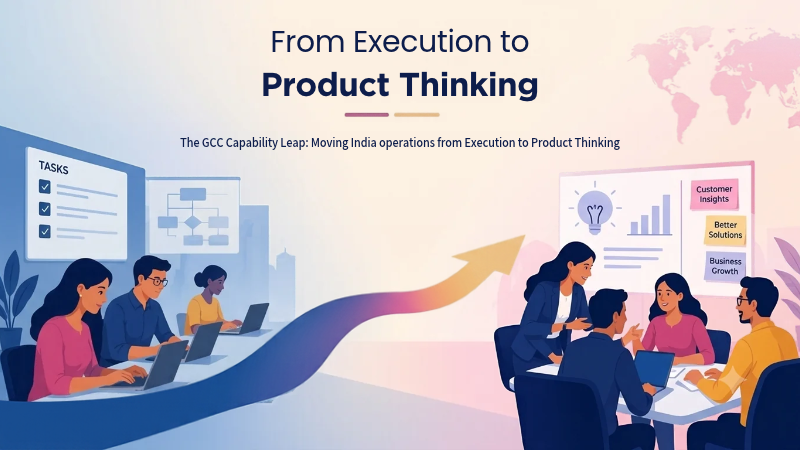
Imagine two teams assigned to solve the exact same business problem.
The first team receives a set of instructions, ticks off every task on time, and reports completion to global headquarters.
The second team pauses to ask a few vital questions: Who is using this product? What problem are we actually solving? How can we make the core experience better? What does customer feedback tell us?
Both teams deliver their code. But the second team also helps shape where the product goes next.
That distinction defines the exact value leap India’s Global Capability Centers (GCCs) are poised to make. For GCC heads and CHROs, this represents an opportunity to reshape how teams are built, how leaders are developed, and how strategic value is demonstrated to the global enterprise.
India’s GCC ecosystem has entered a mature, high-impact phase. The data underscores this shift: according to the Zinnov-Nasscom India GCC Landscape Report 2026, India hosts 2,117 GCCs, employing 2.36 million professionals and generating $98.4 billion in revenue.
While scale is established, the next growth engine lies in ownership, influence, and co-creation across product design, technology architecture, customer experience, and business strategy.
Here is how GCC leaders and talent executives can foster this transition.
1. Reframe Tasks as Business Problems
When tasked with updating a digital platform, an execution-focused team dives straight into task lists to hit the deadline. A team anchored in product thinking steps back to understand the underlying mandate.
They ask tactical, impact-driven questions: Where are users dropping off during checkout? How can friction be reduced? What change delivers the highest value to the user?
Asking these questions connects daily operational tasks directly to high-level business goals. Leaders can catalyze this mindset shift by:
-
Involving engineering and operational teams in initial strategy sessions.
-
Transparently sharing the “why” behind project roadmaps.
-
Encouraging team members to pitch user-focused enhancements.
2. Pair Responsibility with Real Ownership
True ownership cannot exist without domain context, authority, and leadership backing.
When an onshore team understands the customer’s pain points but must await global sign-off for minor iterations, momentum stalls. Conversely, when that same team operates with defined guardrails, clear key performance indicators (KPIs), and a direct channel to global product owners, decision-making velocity increases.
GCC leaders evaluating their current operating posture should consider three core questions:
-
Scope: Which specific product features or business outcomes can the local team own end-to-end?
-
Autonomy: What technical or operational decisions can they execute independently within agreed guardrails?
-
Visibility: How directly are local engineers and managers connected with global strategy stakeholders?
The Nasscom-Zinnov GCC Research confirms that the ecosystem is transitioning toward portfolio and transformation hubs. Decision-making frameworks must evolve to match this operational reality.
3. Upskill Talent for Strategic Influence
Technical execution remains foundational, but long-term value creation requires cross-functional capabilities: customer empathy, business domain analysis, product management, and structured communication.
The Nasscom-Zinnov Mid-Market GCC Report 2025 highlights a telling indicator: 47% of global product management talent within mid-market GCCs is already based in India.
To build on this foundation, CHROs can structure talent frameworks that enable employees to:
-
Participate directly in product discovery and customer research sessions.
-
Analyze raw customer usage data and feedback loops.
-
Collaborate fluidly across technology, business, and design functions.
-
Take direct accountability for measurable business metrics.
While training programs build foundational knowledge, applying that knowledge to real-world business challenges drives genuine leadership maturity.
4. Shift Performance Metrics from Output to Outcomes
The metrics used to measure teams fundamentally shape their operational focus. When performance is evaluated solely on output metrics—such as story points completed or tasks closed—speed and volume become the default targets.
Measuring success through business outcomes provides GCC leaders with clear, quantifiable evidence of their center’s strategic contribution when communicating with global executive teams.
5. Maintain Operational Discipline as a Growth Foundation
Adopting product thinking requires a stable operational core. Core functions—including payroll execution, statutory compliance, financial accounting, and workforce management—must run flawlessly. As a GCC expands, these operational requirements become increasingly complex.
When core operations run reliably through clear governance and automated processes, leadership bandwidth frees up to focus on higher-value priorities like product strategy, talent development, and platform innovation.
Operational discipline and product ownership are mutually reinforcing pillars of a mature GCC.
A Practical Blueprint: The 90-Day Pilot Framework
Attempting to overhaul an entire organizational operating model at once carries significant operational risk. A structured 90-day pilot focused on a single product module or operational workflow offers a controlled testing ground.
Tracking both delivery speed and business impact during this 90-day cycle provides the data needed to demonstrate proof-of-concept to global leadership before scaling the model across other functions.
The Path Ahead
India’s GCC ecosystem has successfully built scale, operational quality, and deep technical capabilities. The next frontier centers on strategic influence.
-
For GCC Heads: The priority is moving past pure service delivery to build environments where teams actively shape product roadmaps.
-
For CHROs: The priority is developing business-minded leaders equipped to drive measurable outcomes across the global organization.
When teams understand broader business goals and are given the authority to make decisions, they consistently find better ways to solve complex problems and create lasting enterprise value.






Leave a reply